Bankers' Hours Were Real — And They Were Absolutely Exhausting to Work Around
Bankers' Hours Were Real — And They Were Absolutely Exhausting to Work Around
Somewhere in a drawer in your grandparents' house, there might still be a small, worn booklet. It looks almost like a tiny ledger — narrow columns of handwritten numbers, rubber-stamped dates, and a running tally of deposits and withdrawals. That's a passbook. And for most Americans in the mid-20th century, it was the only proof they had that their money actually existed.
It seems almost quaint now. But the passbook was just one piece of a banking system that demanded an enormous amount of patience from ordinary people — and gave very little in return.
The Branch Was Your Only Option. Full Stop.
Let's set the scene. It's 1964. You've just been paid. You have a check in your hand, and you need to deposit it. Here's what that process looks like.
First, you have to get to the bank during business hours — typically 9 a.m. to 3 p.m., Monday through Friday. No Saturdays. Definitely no Sundays. If you worked a standard nine-to-five, you were essentially competing with your own job to access your own money. Many Americans had to take time off work, or dash out on a lunch break, just to make a routine deposit.
Once inside, you'd wait in line. You'd hand over your check and your passbook to a teller, who would manually record the transaction. The teller might stamp your book. You'd sign something. And then — here's the part that would make a millennial's eye twitch — you'd wait. Not minutes. Days. Checks routinely took three to five business days to clear, and during that holding period, that money simply wasn't accessible. It existed in a kind of financial purgatory.
If you needed cash on a Wednesday evening? You'd better have planned ahead, because that branch wasn't opening again until Thursday morning.
The ATM Changed Everything (Eventually)
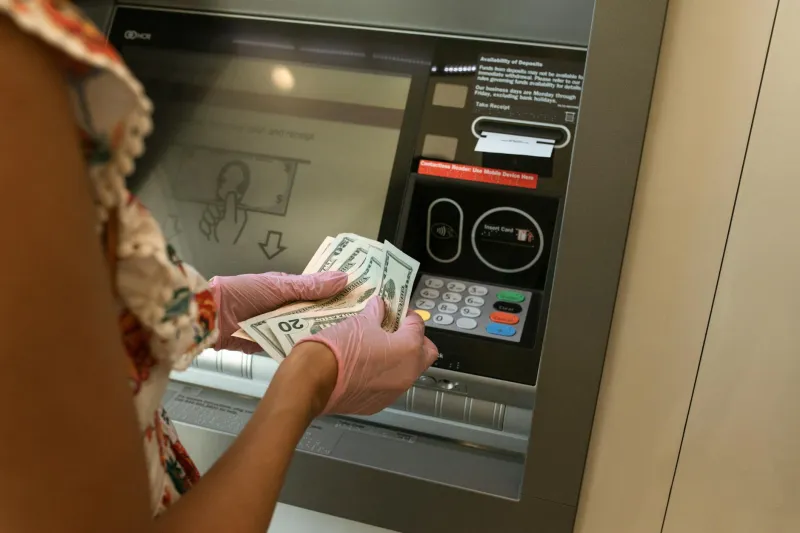
The first ATMs appeared in the U.S. in the late 1960s, but widespread adoption took years. Early machines were limited — they dispensed cash but couldn't accept deposits, and they were attached to specific banks. Your card from First National wasn't going to work at a machine belonging to some other institution across town.
Through the 1970s and into the 1980s, the ATM network slowly expanded and began to interconnect. For the first time, Americans could get cash after hours. It felt radical. People were genuinely suspicious of the machines — there were real concerns about whether they could be trusted, whether the cash would actually be deducted correctly, whether the receipt meant anything at all.
But even with ATMs on the corner, the core banking relationship was still branch-based. Want to open an account? Come in and bring two forms of ID, a utility bill, and probably a reference. Want a loan? Sit across a desk from a loan officer who will look you in the eye and make a judgment call. Banking was, at its heart, a face-to-face transaction.
When the Internet Showed Up, the Clock Started Running
Online banking began appearing in the mid-1990s, though early versions were clunky and limited. Checking your balance online felt like a novelty — a way to avoid calling the automated phone line and punching through twelve menus just to hear a robot read you your last five transactions.
But the real shift came with the smartphone. By the early 2010s, Americans were depositing checks by photographing them. Transferring money between friends took seconds via apps like Venmo and Zelle. Alerts pinged the moment a charge hit your account — not the next day, not after your next statement, but immediately.
Today, you can open a fully functional bank account from your couch in about four minutes. You can freeze your debit card if you think you've lost it, unfreeze it when you find it under the couch cushion, and dispute a charge — all before your coffee finishes brewing. Real-time balance updates mean that the financial fog that once surrounded everyday Americans has almost entirely lifted.
What We Gained — And What We Quietly Left Behind
The convenience is staggering, and it's worth pausing to actually feel that. A generation ago, not knowing your exact balance was a normal condition of life. Overdrafts were a common, embarrassing, expensive reality — not because people were reckless, but because the information simply wasn't available fast enough to act on. Banks collected enormous fee revenue from a system that was, structurally, opaque.
The transparency alone is a kind of quiet revolution.
But there's something worth noting on the other side of the ledger. The friction of old-school banking forced a certain intentionality. You planned. You kept a checkbook register. You thought twice before a trip to the branch, because that trip cost you time. The instant gratification of modern finance — tap to pay, one-click transfer, buy now — has made money feel more abstract and more frictionless than ever. For some people, that's liberation. For others, it's a fast lane to overspending.
The branch teller who knew your name and asked about your kids isn't entirely gone, but they're endangered. The passbook is a museum piece. And the idea of waiting three days to access your own paycheck feels about as distant as rotary phones and rabbit-ear antennas.
We live in the gap between those two worlds — and most of us barely noticed the crossing.