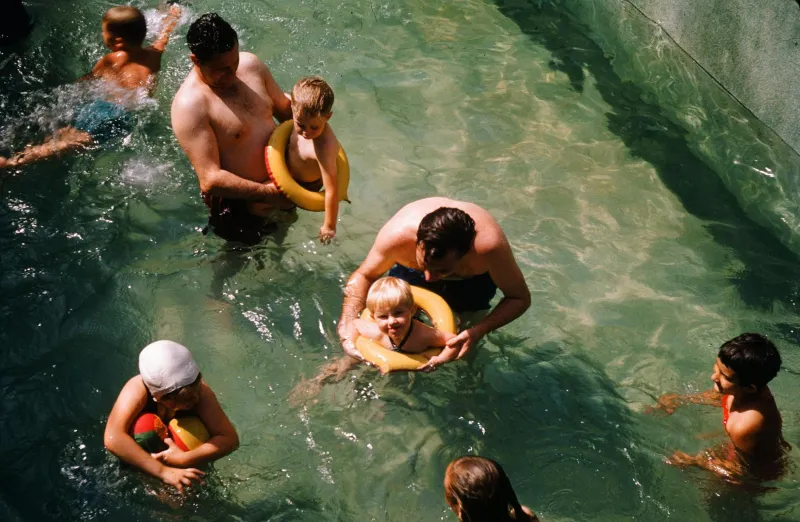
The Test That Could Save Your Life
In 1952, if you wanted to graduate from most American high schools, you had to prove you wouldn't drown. Not in a pool with lane lines and lifeguards — in street clothes, treading water for ten minutes, then swimming 100 yards without stopping.
This wasn't considered cruel or unusual. It was considered common sense. Water was everywhere in American life — rivers, lakes, beaches, quarries, swimming holes. The assumption was simple: if you lived in America, you needed to know how to not die in water.
Today, nearly 60% of American adults can't swim well enough to save their own lives. We've quietly reversed a century of progress in water safety, and most people don't even realize it happened.
When Schools Took Drowning Personally
The mandatory swimming test wasn't just a gym class requirement — it was a civic duty. Schools built pools specifically for this purpose. If your town couldn't afford a pool, they bused kids to the nearest YMCA or public facility until everyone passed.
The tests weren't gentle. At many schools, students had to jump into the deep end fully clothed, tread water, then swim to safety. The message was clear: emergencies don't wait for perfect conditions. If you fell off a dock in your winter coat, you better know how to handle it.
Military academies were even more demanding. West Point required cadets to swim 150 yards, including 50 yards on their backs. The Naval Academy made prospective officers swim a quarter-mile in uniform. The logic was unassailable: if you're going to serve your country, you can't be helpless in water.
 Photo: Naval Academy, via c8.alamy.com
The Infrastructure of Not Drowning
Mid-century America built swimming competency into its social fabric. Public pools weren't just recreation — they were public health infrastructure. Summer camps didn't offer swimming as an activity; they required it as a graduation requirement.
The Red Cross taught standardized swimming curricula in thousands of communities. Local chapters certified instructors who taught identical techniques from Maine to California. There was no debate about swimming styles or philosophies — there was one way to not drown, and everyone learned it.
 Photo: Red Cross, via img.favpng.com
YMCAs made swimming instruction their primary mission. Before they became fitness centers with rock climbing walls and yoga studios, YMCAs existed mainly to keep young Americans from drowning. Their pools were utilitarian — deep, cold, and designed for survival training rather than comfort.
How We Decided Drowning Was Acceptable
The decline started in the 1980s with a perfect storm of budget cuts, liability fears, and shifting educational priorities. School districts facing financial pressure looked at their pools and saw expensive maintenance, insurance headaches, and potential lawsuits.
Pool maintenance was costly and specialized. One broken filtration system could shut down a program for months. One injury could trigger a lawsuit that bankrupted a school district. Administrators did the math and decided swimming wasn't worth the risk.
Meanwhile, academic pressure intensified. Schools needed more time for standardized test preparation. Physical education budgets shrank. Swimming instruction — which required specialized facilities, certified instructors, and significant class time — became an obvious target for cuts.
The Inequality We Created by Accident
When public schools stopped teaching swimming, the skill became a luxury good. Families who could afford private lessons, country clubs, or homes with pools continued raising water-confident children. Everyone else was left behind.
This created a bizarre situation: the Americans most likely to live near water — rural and working-class communities — became the least likely to know how to swim. Kids who grew up around lakes, rivers, and quarries never learned the skills their grandparents considered essential.
The statistics are stark. Today, 70% of African American children and 60% of Hispanic children can't swim. This isn't a cultural preference — it's the direct result of decades of declining public swimming instruction and pool closures in urban communities.
What Survival Skills Actually Look Like
The old swimming tests weren't about producing Olympic athletes — they were about creating a generation that wouldn't panic in water. Students learned to float on their backs for extended periods, conserving energy. They practiced treading water while removing shoes and heavy clothing. They learned to swim long distances without speed or style, just endurance.
These weren't swimming lessons; they were survival training. The goal wasn't perfect form but practical competence. Can you stay afloat long enough for help to arrive? Can you swim to shore if you fall off a boat? Can you rescue someone else without drowning yourself?
Modern swimming instruction, when it exists at all, focuses on technique and competition. Kids learn proper stroke mechanics but may never practice swimming in clothes or treading water for extended periods. They're technically better swimmers but less prepared for actual emergencies.
The Assumption We Abandoned
For most of American history, swimming competency was considered as basic as literacy. You didn't graduate high school without proving you could read, write, and not drown. This wasn't seen as an unreasonable burden but as a fundamental preparation for adult life.
The assumption was that American citizens should be physically self-reliant. If you fell into water, you saved yourself. If someone else was drowning, you knew how to help without becoming a victim. These weren't superhuman expectations — they were baseline competencies for living in a country surrounded by water.
Today, we've replaced that assumption with the belief that water safety is someone else's responsibility. Lifeguards will save you. Coast Guard helicopters will rescue you. Technology will track your location and send help.
But water doesn't wait for rescue services. Drowning happens in seconds, often in shallow water, often within reach of safety. The skills that once seemed so essential — staying calm, conserving energy, swimming steadily toward shore — are exactly what people need when modern rescue systems fail.
We've traded a nation of competent swimmers for a nation of helpless victims. And somehow, we've convinced ourselves this represents progress.