When Streetlights Meant Come Home: How American Kids Lost Miles of Freedom
The Geography of a 1970s Childhood
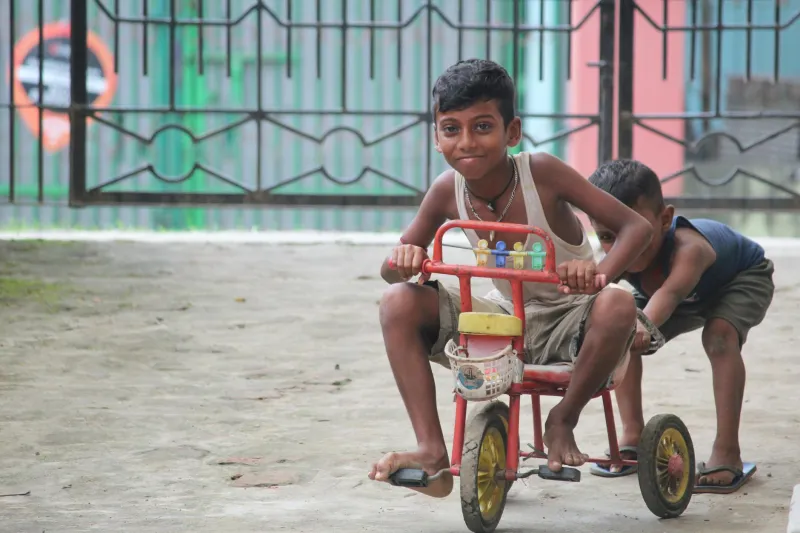
In 1975, the average American child roamed freely within a radius of about six miles from home. They left after breakfast with a simple instruction: "Be back when the streetlights come on." They built tree houses in woods that felt like wilderness, rode bikes to friends' houses across town, and spent entire summer days in territories their parents had never seen.
Today, that radius has shrunk to about 300 yards.
This isn't a story about nostalgia or "kids these days." It's about one of the most dramatic changes in American childhood that somehow happened without anyone officially deciding it should. In the span of a single generation, we redefined what it means to be a child — and most of us didn't even notice it was happening.
The Invisible Leash Gets Shorter
Research by environmental psychologist Roger Hart tracked this transformation by studying children's "home ranges" — how far kids typically ventured from their houses. In the 1970s, children regularly walked or biked to school, explored vacant lots, built forts in nearby woods, and organized their own games in parks and fields.
Parents expected this independence. Sending a 10-year-old to the store for milk wasn't neglect — it was normal child development. Kids learned navigation, problem-solving, and social negotiation through unsupervised exploration. They discovered shortcuts, secret places, and developed what psychologists call "spatial confidence."
By 2000, Hart found that same freedom had largely vanished. Children moved through the world in adult-chaperoned bubbles, traveling from one supervised activity to another. The woods where previous generations built forts became "stranger danger" zones. The corner store became too far and too risky for a solo mission.
When Fear Replaced Common Sense
What changed? It wasn't the actual safety statistics. FBI data shows that crimes against children have generally decreased since the 1970s. Child abductions by strangers — the fear that drives much parental anxiety — occur at roughly the same rate they always have: extraordinarily rarely.
But our perception of danger exploded. The missing children's faces that began appearing on milk cartons in 1984 created an illusion of epidemic that statistics didn't support. Cable news amplified every tragic story, making distant horrors feel like neighborhood threats. "Stranger danger" campaigns, however well-intentioned, taught children that the world beyond their front door was fundamentally unsafe.
Legal culture shifted too. Parents began facing charges for letting children play unsupervised in parks or walk to school alone — behaviors that had been completely normal just decades earlier. The legal system, designed to protect children, began criminalizing the very independence that had defined healthy childhood development.
The Scheduled Generation
As free-range exploration disappeared, organized activities expanded to fill the void. Soccer practices, music lessons, tutoring, and playdates became the primary way children experienced the world beyond home and school. But there's a crucial difference between supervised activities and independent exploration.
When kids organize their own games, they learn to negotiate rules, resolve conflicts, and adapt to changing circumstances. When adults run the show, children become consumers of entertainment rather than creators of experience. They learn to follow instructions rather than make decisions.
The average American child now spends just 30 minutes per day in unstructured outdoor play, compared to seven hours per day of screen time. Recess has shortened or disappeared entirely in many schools. Even playgrounds have been redesigned to eliminate most physical challenges that might result in scraped knees or bruised egos.
What We Lost in Translation
The shrinking of childhood geography represents more than just less exercise or outdoor time. Independent exploration taught crucial life skills that are difficult to replicate in supervised environments.
Navigation skills, for instance. Before GPS, children developed internal maps of their neighborhoods, learned to read landmarks, and gained confidence in finding their way. Today's kids often can't navigate their own neighborhoods without digital assistance.
Risk assessment was another casualty. Climbing trees, riding bikes on busy streets, and exploring construction sites taught children to evaluate danger and make safety decisions. Bubble-wrapped childhoods produce teenagers who struggle to assess real risks because they've never practiced with smaller ones.
Social development suffered too. When children of different ages played together unsupervised, older kids naturally taught younger ones, creating multi-age social learning that's rare in today's age-segregated, adult-supervised activities.
The Anxiety Epidemic
Psychologists increasingly link the rise in childhood anxiety and depression to this loss of independence. Children who never experience autonomy struggle to develop confidence in their own judgment. They become dependent on adult validation for every decision.
Paradoxically, our efforts to protect children from every possible harm may have made them more vulnerable to the psychological challenges of growing up. Kids who never face manageable risks in childhood often struggle with major life transitions in adolescence and young adulthood.
Pockets of Resistance
Some communities are pushing back. The "Free-Range Kids" movement advocates for returning reasonable independence to children. Some schools have eliminated "stranger danger" programs in favor of teaching practical safety skills. A few neighborhoods have organized to create "walking school bus" routes where children can travel in groups without constant adult supervision.
Certain cities have designated "children's walking zones" where kids are explicitly encouraged to explore independently. These initiatives recognize that childhood mobility isn't just about exercise — it's about developing the confidence and competence that defines healthy development.
The Real Danger We're Avoiding
The greatest risk to today's children may not be stranger abduction or playground injuries — it may be raising a generation that's afraid of independence and incapable of navigating the world without constant guidance.
When we eliminated unsupervised outdoor play, we didn't just change how children spend their time. We changed how they develop courage, creativity, and confidence. We traded the small, manageable risks that build resilience for the larger psychological risks that come with overprotection.
The streetlight that once called children home has been replaced by smartphone tracking and scheduled pickups. We know exactly where our kids are at all times — but we may have forgotten why we wanted them to wander in the first place.