The Books That Answered Everything — Before Answering Everything Got Easy
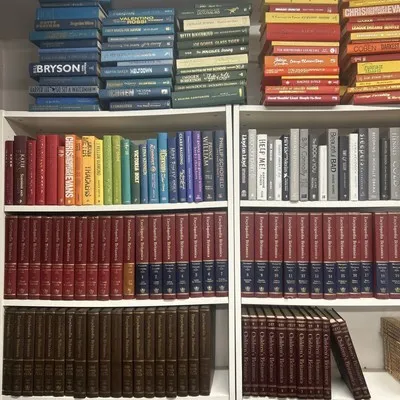
Photo: vintage encyclopedia britannica world book set family living room bookshelf 1970s, via i.ebayimg.com
The Shelf That Held the World
There was a specific kind of afternoon that millions of American kids experienced at some point in the twentieth century. You weren't supposed to be reading. You were supposed to be doing homework, or cleaning your room, or doing something useful. But you'd pulled a volume off the encyclopedia shelf — maybe it was the E volume, maybe it was P — and three hours had passed without you noticing.
You'd started with elephants. Then you'd followed a cross-reference to East Africa. Then to the Nile. Then to ancient Egypt. Then to hieroglyphics, which led somehow to linguistics, which had a sidebar about the Rosetta Stone, and now you were reading about Napoleon's Egyptian campaign when you were supposed to be setting the table for dinner.
No algorithm put that path in front of you. No platform served you content it thought you'd engage with. You just followed your own curiosity through a physical object, turning pages, and your brain did the connecting.
That experience — accidental, unhurried, surprisingly deep — is almost entirely gone. And it's worth asking what we lost when it left.
The Encyclopedia as Family Investment
For much of the twentieth century, purchasing a set of encyclopedias was a significant household decision. A full set of Encyclopædia Britannica in the 1970s cost somewhere between $400 and $1,400 depending on the edition — roughly $3,000 to $10,000 in today's dollars. World Book was somewhat more affordable, which is why it dominated the market in middle-class homes across the country. Funk & Wagnalls occupied the budget tier, famously available at grocery store checkout lines for a few dollars per volume over many weeks.
 Photo: Encyclopædia Britannica, via www.deskmodder.de
The price point meant something. Families who bought encyclopedias weren't buying decoration. They were making a deliberate statement about education, about the value of having information at hand, about what kind of household they wanted to be. The encyclopedia shelf was a signal — to guests, to children, to the family itself — that knowledge mattered here.
Door-to-door salespeople built entire careers on this aspiration. Encyclopedia sales representatives were among the most skilled in American commerce, because they weren't selling books — they were selling the idea of a better-educated child, a more capable family, a home that took learning seriously. The pitch worked because the aspiration was genuine. Parents really did believe that having the books would make a difference.
And honestly? They weren't wrong.
How the Encyclopedia Shaped the Way Americans Thought About Knowledge
The encyclopedia did something that's hard to appreciate until it's gone: it established a shared understanding of what authoritative information looked like.
Every entry was written by an expert, edited by a staff, reviewed for accuracy, and printed with the institutional weight of a publisher that had been doing this for decades. Britannica traced its origins to 1768 Edinburgh. World Book had been a household presence since 1917. These weren't websites that anyone could edit. They were institutions — fallible, occasionally dated, but fundamentally committed to a standard of accuracy that readers could feel in the heft of the volumes.
This shaped how Americans approached looking things up. You went to the encyclopedia because it had the answer — or at least a careful, considered version of it. The act of consulting an encyclopedia was implicitly an act of deference to expertise. You weren't crowd-sourcing. You weren't reading opinion. You were accessing a curated body of human knowledge assembled by people who'd spent their careers doing exactly that.
The epistemological lesson embedded in that act was quiet but powerful: some sources are more reliable than others, expertise is real, and the process of verifying information matters.
The Serendipity Factor
Here's the thing about physical encyclopedias that digital search has never successfully replicated: the adjacent discovery.
When you looked something up in a physical volume, you inevitably saw the entries on either side of it. You couldn't help it. The format forced peripheral vision. If you were looking up Mercury (the planet), you might notice Mesopotamia two pages earlier, or Meteorology right after. If the diagrams caught your eye, you'd stop. If a sentence in an adjacent entry raised a question, you'd read on.
This wasn't inefficiency. It was learning. The cognitive scientists call it "incidental acquisition" — absorbing information you weren't specifically seeking. Studies consistently show that incidental learning produces stronger long-term retention than targeted retrieval. You remember the thing you stumbled across more reliably than the thing you searched for directly.
Google is extraordinarily good at getting you exactly what you asked for. It is not designed to give you anything you didn't ask for, and increasingly, it's designed to answer your question so efficiently that you never have to leave the search results page at all. The journey from question to answer has been compressed from an afternoon to eleven seconds.
What's lost in that compression is everything that used to happen in the middle.
The End of the Era
The encyclopedia industry collapsed with remarkable speed once the internet arrived. Microsoft Encarta, a CD-ROM encyclopedia launched in 1993, was the first blow — it offered comparable content at a fraction of the price and fit in a jewel case. By the late 1990s, print encyclopedia sales had fallen off a cliff.
Britannica stopped printing its physical edition in 2012 after 244 years in continuous publication. World Book still produces a print edition, but it's a shadow of its former market presence. Wikipedia, launched in 2001, completed the disruption — offering a free, constantly updated, collaboratively maintained alternative that made the economics of print encyclopedias permanently unworkable.
Wikipedia is genuinely remarkable. It is vast, mostly accurate, freely accessible to anyone on earth with an internet connection, and updated in real time. It is also editable by anyone, inconsistently sourced, and read almost entirely in a context of rapid retrieval rather than leisurely exploration. It is not a replacement for the experience of sitting on the living room carpet with a volume open across your knees on a Tuesday afternoon.
A Question Worth Sitting With
We have access to more information today than any previous generation in human history. The entire Britannica, all 32 volumes and 44 million words of it, is available online. Every question you could ever ask has an answer within reach in seconds.
And yet there's something worth interrogating in the assumption that faster always means better when it comes to learning. The friction that used to exist between a question and its answer — the physical act of pulling a volume off a shelf, finding the right page, reading the entry, following the cross-references — wasn't purely inefficiency. Some of it was the learning itself.
The encyclopedia didn't just store knowledge. It modeled a relationship with knowledge: patient, curious, willing to follow a thread without knowing where it led.
That's a harder thing to put on a shelf. But it might be the thing we most need to find again.