You Used to Call Dr. Hendricks. Now You Call a Search Bar.
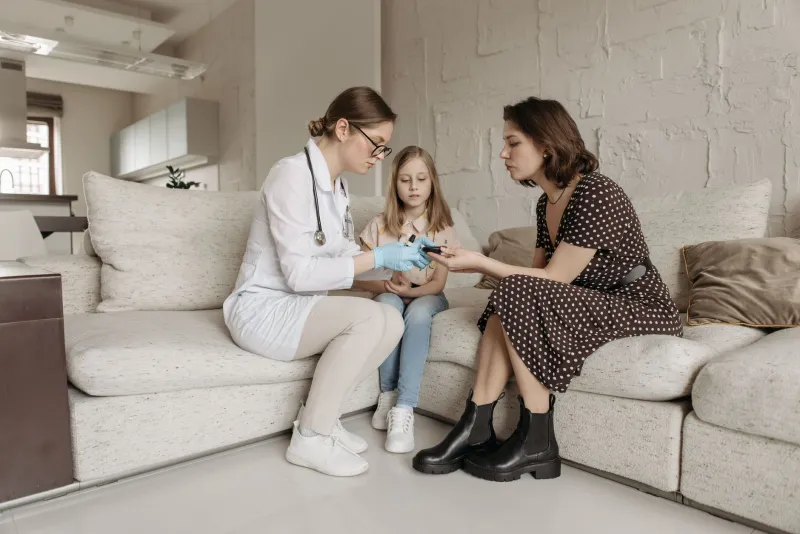
Somewhere around 1987, when Linda Kowalski's youngest came down with a fever that wouldn't quit, she picked up the kitchen phone and called Dr. Hendricks. Not his office. Him. He answered, asked a few questions, and told her what to watch for. He'd been her family's doctor for eleven years. He already knew about her son's ear infections, her husband's blood pressure, and the fact that her oldest had a tendency to spike high fevers that usually resolved on their own.
 Photo: Linda Kowalski, via www.name.baby
That call took four minutes. It cost nothing. And it was completely normal.
That world is essentially gone.
The Doctor Who Knew Your Name — and Your File
For most of the twentieth century, the family physician was something closer to a trusted household advisor than a service provider you booked through an app. Primary care doctors in mid-century America carried patient histories in their heads as much as in their files. They delivered babies, set broken arms, managed chronic conditions, and answered worried calls from parents at reasonable hours of the evening. The relationship was ongoing, personal, and built on years of accumulated context.
This wasn't just a small-town phenomenon, either. Urban neighborhoods had their own version — the doctor whose office was three blocks away, who saw the same families decade after decade, and who could tell from the sound of your voice whether you actually needed to come in.
The phrase "my doctor" used to mean something specific. It meant a person. Someone who recognized your face and remembered your history without having to scroll through a chart.
When the System Got Too Big to Stay Personal
The fractures started forming in the 1980s and deepened through the 1990s. Managed care, insurance networks, and the rising cost of running a private practice began pushing physicians into larger group settings. Solo practitioners became rare. The paperwork multiplied. The number of patients each doctor was expected to see in a day climbed steadily upward.
By the time the internet arrived in American living rooms, the personal physician relationship was already under strain. What the internet did was accelerate the retreat.
WebMD launched in 1996. Symptom checkers followed. Health forums multiplied. Suddenly, Americans had access to an enormous volume of medical information — and almost no ability to interpret it accurately for their own situation. A headache that had once prompted a two-minute call to Dr. Hendricks now triggered a forty-five-minute spiral through worst-case scenarios online, ending either in panic or false reassurance, rarely in actual clarity.
The Symptom Checker Doesn't Know You Had Mono in College
Here's what the algorithm can't do: it can't remember that you mentioned chest tightness at your last appointment, or that your family has a history of anxiety that tends to present as physical symptoms, or that you're the type of person who catastrophizes at midnight but is usually fine by morning.
Your former family doctor knew all of that. The search bar knows none of it.
The average primary care physician in the United States today manages somewhere between 1,500 and 2,500 patients. Appointment slots run fifteen minutes on a good day. Many Americans now see a different provider every visit — a rotating cast of nurse practitioners, physician assistants, and doctors-they've-never-met operating from whatever the electronic health record says happened last time.
The continuity that made old-school medicine genuinely useful has been quietly dismantled, and we replaced it with a combination of overloaded clinics and consumer-grade internet research.
What We Actually Lost
The loss isn't just sentimental. There's real clinical value in a doctor who knows you over time. Studies consistently show that continuity of care leads to better outcomes — fewer unnecessary tests, fewer missed diagnoses, lower hospitalization rates, and higher patient satisfaction. Patients who see the same physician regularly are more likely to follow through on treatment plans and more likely to mention symptoms they might otherwise dismiss.
When that relationship disappears, patients fill the gap themselves. And most of them fill it with Google.
The result is a strange paradox: Americans today have access to more health information than any generation in history, and many feel less informed and more anxious about their health than their parents did. The information is abundant. The judgment — the human, contextual, relationship-based judgment — is what's scarce.
Telemedicine Tried to Rebuild the Bridge
The pandemic accelerated telemedicine in ways that would have seemed radical five years earlier. Video appointments became standard almost overnight. For a moment, it felt like technology might actually reconstruct something resembling the old doctor-patient dynamic — accessible, conversational, without the three-week wait for an in-person slot.
And in some ways, it helped. Telehealth removed genuine barriers for patients in rural areas, people with mobility issues, and anyone dealing with a straightforward concern that didn't require a physical exam. That's real progress.
But a twelve-minute video call with a doctor you've never met isn't the same as a relationship. It's a transaction. A useful one, sometimes. But not the same thing.
The Gap We Keep Scrolling Past
Most Americans under forty have never experienced what it actually felt like to have a personal physician in the old sense. They've grown up in the era of the search bar, the urgent care walk-in, and the symptom checker that always seems to suggest either nothing or something terrifying. They assume that's just how medicine works.
It isn't how it always worked. And the distance between what we have now and what we quietly gave up is significant enough to be worth noticing.
Dr. Hendricks retired in 2001. His patients scattered across a health system that no longer had a slot for what he represented. Most of them are still out there — older now, navigating a medical landscape that's technically more advanced than anything he could have offered, and somehow lonelier for it.
The four-minute phone call that cost nothing is gone. What replaced it costs considerably more and knows considerably less about who you are.