There Was No 911. For Most of American History, Getting Help Was Up to You.
There Was No 911. For Most of American History, Getting Help Was Up to You.
If you're under fifty, you've probably never had to think about how to call for help in an emergency. You dial 911. That's it. Someone answers. You tell them what's happening. Help comes.
It feels as permanent and obvious as gravity.
It isn't. The nationwide 911 system as Americans know it today is, by any historical measure, brand new. And the patchwork of chaos it replaced was responsible for an unknowable number of deaths that simply didn't have to happen.
What "Calling for Help" Actually Meant Before 911
Imagine this: it's 1965. Someone in your household collapses. You need an ambulance.
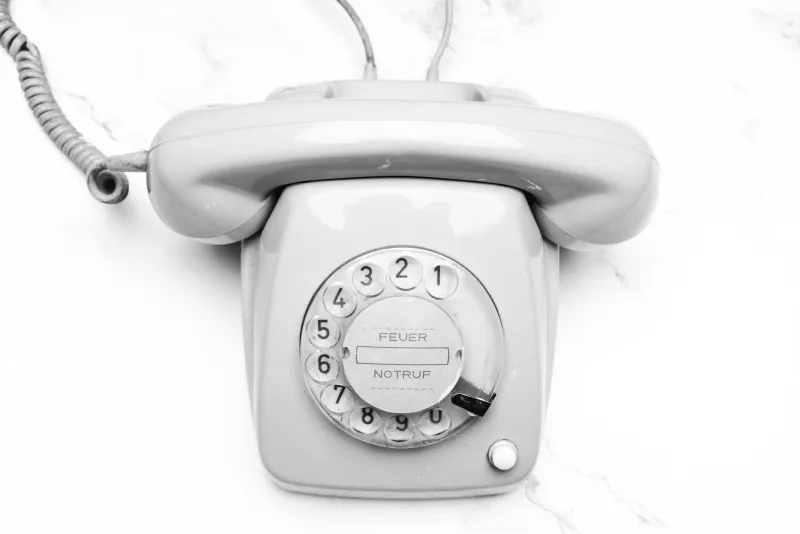
You pick up the phone. You call — who, exactly? There is no universal number. In most American cities, emergency services are fragmented across multiple agencies, each with its own direct line. The fire department has one number. The police department has another. The hospital might dispatch ambulances, or a local funeral home might — yes, funeral homes operated ambulances in many parts of the country well into the 1960s, partly because they already owned vehicles large enough to transport a body.
If you know the right number, you might get through quickly. If you don't — if you're in an unfamiliar neighborhood, if you've just moved, if you're a visitor — you might call information and wait. You might try a number that rings unanswered. You might call the wrong agency and get transferred, or not transferred at all.
And if you're in a rural area, the situation could be even more uncertain. Some counties had no formal ambulance service whatsoever.
The time lost in those moments of confusion wasn't abstract. For a cardiac arrest, brain damage begins within four to six minutes of oxygen deprivation. For a stroke, every minute of delayed treatment costs neurons. The fragmented emergency system of mid-century America wasn't just inconvenient. It was, by modern standards, a public health crisis hiding in plain sight.
The Moment Someone Decided to Fix It
The push toward a unified emergency number has a specific origin point, and it came from a place you might not expect: a 1967 report by the President's Commission on Law Enforcement and Administration of Justice.
The commission's findings were stark. Across the United States, there was no standard method for citizens to contact emergency services. Response times were inconsistent. Dispatch systems were outdated. The commission recommended the creation of a single, nationwide emergency number.
AT&T — at the time the dominant telephone provider in the country — responded by announcing in 1968 that it would establish 911 as the emergency number across its network. The first 911 call in American history was made on February 16, 1968, in Haleyville, Alabama, by the town's mayor to the local police chief. It was a demonstration call, staged for the occasion. But it marked the beginning of something real.
The Rollout Was Anything But Fast
Here's where the story gets complicated — and where the now gap becomes genuinely startling.
That 1968 announcement did not mean 911 was suddenly available everywhere. Not even close. Implementing a unified emergency system required infrastructure investment, coordination between thousands of local governments, upgrades to telephone switching equipment, and the creation of Public Safety Answering Points — the dispatch centers that actually receive the calls.
Progress was slow and deeply uneven. By 1976, only about 17 percent of the U.S. population had access to 911 service. Rural areas lagged years, sometimes decades, behind urban centers. As late as 1987, roughly half of the country still didn't have 911 coverage.
The Wireless Communications and Public Safety Act of 1999 — passed more than thirty years after that first call in Alabama — finally mandated the establishment of 911 as the universal emergency number and pushed the framework toward the wireless age. Enhanced 911, which allows dispatchers to identify a caller's location automatically, took even longer to implement comprehensively.
The system that feels like it has always existed was, for a huge portion of the country, not fully functional until well within living memory.
The Human Cost of the Gap
It's impossible to calculate precisely how many lives were lost or permanently altered because someone dialed a wrong number, waited too long on hold, or simply didn't know who to call. That data doesn't exist in any clean form.
What we do know is that the research on response time is unambiguous. Survival rates for cardiac arrest drop by roughly 10 percent for every minute without intervention. Stroke outcomes are directly tied to how quickly treatment begins. Trauma patients have what emergency medicine calls the "golden hour" — a window in which rapid treatment dramatically changes survival odds.
Every structural barrier between a person in crisis and the help they needed cost time. And time, in those situations, cost lives.
The System We Take for Granted
Today, 911 handles more than 240 million calls per year in the United States. Modern dispatch systems can pinpoint a caller's location from a cell phone with increasing precision. Text-to-911 is available in many jurisdictions for people who cannot safely speak. First responders are dispatched in seconds.
None of this happened automatically. It was built — slowly, imperfectly, over decades — by people who recognized that a country leaving emergency response to local improvisation was a country accepting preventable death as a background condition of life.
The next time you see those three digits on a keypad, it's worth remembering that they represent one of the most consequential public safety decisions in American history. And that for most of the twentieth century, they simply weren't there.