Eight O'Clock Sharp: The Night America Sat Down Together and Watched the Same Thing

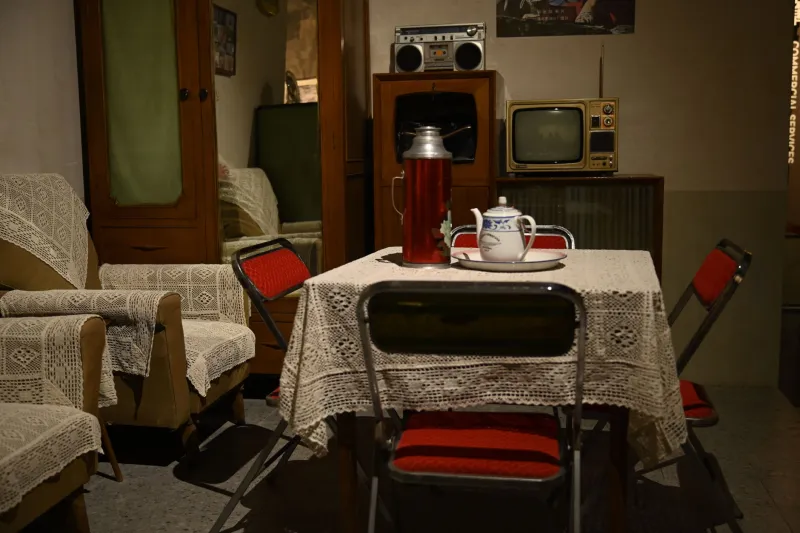
There's a version of Tuesday night in 1954 that's almost impossible to imagine now. Somewhere in the neighborhood, in house after house, families were doing the exact same thing at the exact same moment. The dishes were done, the kids were in pajamas, and everyone had arranged themselves around a single piece of furniture because Milton Berle was about to come on. Not later. Not whenever. Now.
That word — now — used to mean something very specific in American entertainment. It meant the show was starting, and if you weren't ready, you missed it.
The Radio Came First
Before television reshaped the living room, radio had already established the habit. In the 1930s and 1940s, the family gathered around the radio the way an earlier generation had gathered around the fireplace — not by choice exactly, but by gravity. The schedule dictated the rhythm of the evening.
Amos 'n' Andy at 7 p.m. The Jack Benny Program on Sunday nights. Fibber McGee and Molly drawing audiences so large that telephone usage reportedly dropped during its broadcast. These weren't just shows. They were shared national events, happening in real time, in every home that had a radio — and by 1940, that was about 80 percent of American households.
The experience of listening together wasn't incidental. It was the whole point. Families laughed at the same joke at the same second. Children sat quietly for an hour because the alternative was missing something everyone at school would talk about tomorrow. Entertainment was appointment-based not because of corporate scheduling strategy but because there was simply no other option — and the constraint created something valuable almost by accident.
Television Raised the Stakes
When television arrived and spread through American homes in the late 1940s and 1950s, it inherited radio's appointment culture and amplified it visually. The shared experience didn't just survive the transition — it intensified.
By the time I Love Lucy was airing in the early 1950s, it was pulling in audiences of 60 million viewers for a single episode. Not over a weekend. Not across a week of on-demand viewing. One night. One hour. Sixty million people watching Lucy stuff chocolates into her mouth at the exact same moment, laughing together across a continent.
The water cooler conversation that followed wasn't a metaphor — it was a genuine cultural mechanism. You had to have seen it to participate in the next day's conversation. Shared entertainment created shared vocabulary, shared references, shared experience. It was, in a quiet and underappreciated way, social infrastructure.
The Schedule Was the Community
This is the part that gets overlooked in most conversations about streaming and choice. The inconvenience of scheduled television — you watch when they broadcast, not when you feel like it — was also its greatest social feature.
Because everyone was constrained by the same schedule, everyone arrived at the same cultural moments together. The finale of M*A*S*H in 1983 drew 106 million viewers. Not because it was algorithmically served to people who'd shown interest in wartime dramedy. Because it was on, it was the finale, and America showed up. That number has never been approached since — not by any streaming event, not by any Super Bowl halftime show, not by anything.
The shared schedule created a kind of cultural synchrony that nobody designed and nobody fully appreciated until it started to unravel.
When Choice Became Fragmentation
The unraveling happened gradually. Cable in the 1980s began splitting audiences. VCRs let people time-shift. DVRs made the schedule feel optional. And then streaming arrived and made it genuinely irrelevant.
Netflix's binge-drop model, which became standard after House of Cards in 2013, was the final structural break. When an entire season drops at once, there is no shared moment of discovery. Some people watch episode one on release day. Some people wait six months. Some people never watch it at all but absorb enough about it through cultural osmosis to fake their way through a conversation.
The result is a landscape of almost total entertainment fragmentation. Netflix alone has thousands of titles. Disney+, HBO Max, Apple TV+, Peacock, Paramount+ — the catalog is effectively infinite. At any given moment, Americans are watching thousands of different things, alone or in small groups, on their own schedules, with their own algorithms curating their own feeds.
No single show commands the culture the way Seinfeld or Friends did in the 1990s, not because the writing is worse but because the audience can't be gathered in the same place at the same time anymore. The mechanism for shared cultural experience has been dismantled, piece by piece, in the name of convenience.
What Appointment Entertainment Actually Gave Us
It's easy to romanticize the era of three channels and no remote. Nobody is arguing that the old model was better in every way — the lack of choice was genuinely limiting, representation was poor, and plenty of what aired was mediocre.
But the scheduling constraint did something that infinite choice cannot: it synchronized experience. It gave strangers something to talk about. It gathered families around a single point of attention in an age before every person in the household had their own screen, their own queue, their own algorithm.
The now gap here isn't just about entertainment. It's about what happens when a culture stops watching the same thing at the same time. It turns out the schedule wasn't just a broadcast logistics problem. It was the architecture of something shared. And we traded it for the freedom to watch whatever we want, whenever we want, entirely alone.