The Building That Believed in You: When the Public Library Was America's Greatest Equalizer
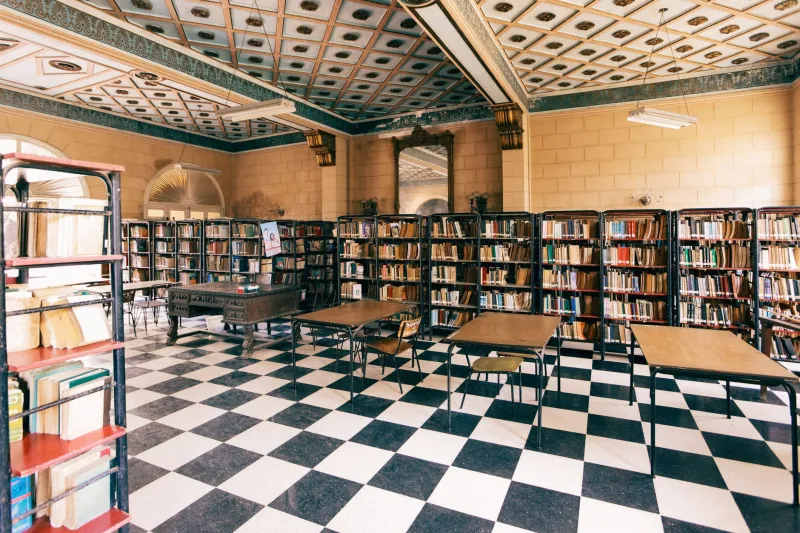
Walk into a Carnegie library built in 1903 and you'll notice something the architects put there deliberately. The entrance is elevated. You climb steps to get inside. That wasn't about aesthetics or flood prevention. It was a statement. Knowledge, the design declared, is worth ascending toward.
Andrew Carnegie funded nearly 2,500 libraries across the English-speaking world between 1883 and 1929. He was a man who had educated himself through free library access as a poor Scottish immigrant in Pittsburgh, and he believed — with the intensity of someone who had lived the proof — that a building full of books could change the course of a life. He wasn't wrong. And for most of the twentieth century, the American public library operated on exactly that belief.
What the Card Catalog Actually Represented
Before the internet, before Wikipedia, before you could type a question into a search bar and get seventeen answers in 0.4 seconds, there was the card catalog. It was a chest of small wooden drawers, each filled with index cards, each card representing a book, each book representing a door.
To a kid who grew up without money, without encyclopedias at home, without parents who had gone to college, the card catalog was a genuinely radical object. It said: everything here is available to you. Not to the people who could afford it. Not to the people with the right credentials. To you, with your library card that cost nothing and expired never.
The library card was, in a very real sense, America's most democratic document. It didn't care what your father did for work. It didn't care what neighborhood you came from. You walked up to the desk, you showed your card, and the librarian — who was, in most cases, a remarkably well-read and underappreciated professional — helped you find what you needed.
This wasn't a small thing. For millions of Americans across the twentieth century, the public library was the primary gateway to self-improvement, to career advancement, to the simple pleasure of reading something beyond what was available at home. It was where immigrants learned English. Where job-seekers researched industries. Where curious teenagers found books their schools didn't teach and their parents didn't own.
The Heyday, and What It Looked Like
Through the 1950s, 60s, and 70s, American public libraries were cultural anchors in a way that's genuinely difficult to convey to someone who grew up with a smartphone. Saturday morning at the library was a ritual for an enormous percentage of American kids. Summer reading programs kept children engaged for three months. The library was where you went to do your homework, yes — but also where you went to browse, to wander, to pick up something you hadn't planned to pick up and discover it changed how you saw something.
Librarians curated. They knew their collections the way good booksellers know their shelves. They could tell in five seconds whether the kid standing in front of them wanted Island of the Blue Dolphins or My Side of the Mountain. They remembered what you'd checked out before. They made suggestions. They were, in the truest sense, guides — and they were free.
The institution also functioned as a community space in ways that went well beyond books. Libraries hosted lectures, film screenings, civic meetings, ESL classes, and local history exhibits. They were places where the public gathered to think together, which is a function that sounds simple until you notice how few places still do it.
The Internet Changed Everything — Except the Need
It would be dishonest to pretend the internet didn't do something genuinely extraordinary. The democratization of information that the public library represented for a century has been, in raw terms, massively amplified by the web. You can access more knowledge in ten minutes of searching than a 1965 library card could have unlocked in a month.
But access to information and access to knowledge are not the same thing. The internet delivers volume. The library, at its best, delivered context, curation, and guidance. It delivered a human being who could help you figure out not just what you were looking for, but what you actually needed. And it delivered that in a physical space — a quiet, climate-controlled, welcoming room — that had no agenda except to serve the people who walked through its doors.
As digital access expanded, library funding did not keep pace. Budgets were cut on the logic that people could find things online now. Collections stopped growing at the rate they once had. Librarian positions were reduced or eliminated. In some communities, hours were slashed. In a handful of cities, branches closed entirely.
The irony is that need for libraries didn't decline with the internet — in many communities, it intensified. People experiencing homelessness use libraries as safe daytime spaces. People without home internet access use library computers for job applications, telehealth appointments, and remote schoolwork. People navigating complex government systems rely on librarians to help them understand what they're looking at. The library's role as an equalizer didn't become obsolete. It just stopped receiving the funding that role required.
What the Building Still Believes
The most striking thing about walking into an American public library today is that the original promise is still there. Battered, maybe. Underfunded, often. But still there.
Libraries now lend Wi-Fi hotspots, seed packets, tools, and museum passes. They host job fairs and tax prep assistance and story times in a dozen languages. They're doing more than they've ever done with less than they've ever had.
And somewhere in most of them, there's still a librarian who will look up from what they're doing and ask if you need help finding something. Not an algorithm. Not a sponsored result. A person, in a building that was built on the idea that knowledge should belong to everyone.
That idea used to feel obvious in America. The fact that it now feels almost radical tells you something important about the distance between where we started and where we've arrived.