The Yellow Envelope That Let You Grieve Before the Grief Hit
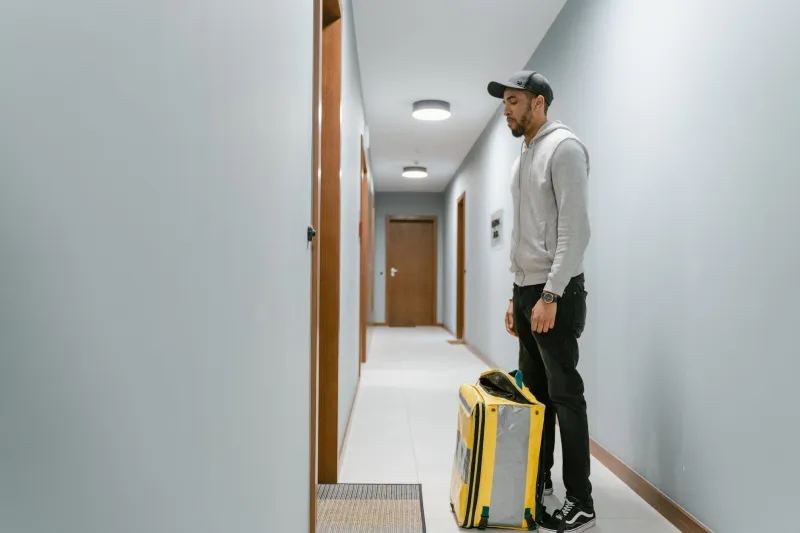
The Western Union messenger was a figure that mid-century Americans recognized immediately — and dreaded. During World War II, a telegram delivery to your front door was enough to make a neighborhood go quiet. Wives and mothers knew what the yellow envelope meant before they opened it. The walk from the door to the kitchen table to read the words could take a very long time.
 Photo: Western Union, via c8.alamy.com
But here's the thing almost nobody talks about anymore: the delay built into that system — the days or weeks between an event and its notification — wasn't only a limitation. It was, in a way, a form of protection. Not from the grief itself, but from its most savage version: the kind that hits before you can breathe, before anyone is beside you, before the world has had any chance to arrange itself around what just happened.
News That Traveled at the Speed of Horses
For most of American history, information moved at the pace of physical transportation. A letter from a soldier in Virginia took days to reach a family in Ohio. A business failure in New York might not reach creditors in Chicago for a week. A death in the family — even a sudden one — arrived as a written account of something that had already ended, already been witnessed by others, already begun to settle into the past tense.
This wasn't experienced as a gift at the time. People hated waiting. The uncertainty between an event and its news was its own particular torture. Families of soldiers during the Civil War described the period before a letter arrived as a sustained, breathless anxiety that could last months.
 Photo: Civil War, via p2.bahamut.com.tw
But once the news came, it came into a context. It arrived at a house, in a community, surrounded by people who could immediately respond. Neighbors showed up. Churches organized. Extended family began making arrangements to travel. By the time the bereaved person had fully absorbed what the letter said, there were already arms around them.
The Telegram as Emotional Architecture
The telegraph era — roughly the 1840s through the mid-twentieth century — compressed the timeline significantly but preserved something of the same structure. News still arrived as a discrete event. You received it, you reacted, and the people around you could see you receive it and react.
There was a social ritual embedded in that process. Neighbors who saw the Western Union messenger stop at a house would come over. Communities developed informal protocols for supporting families before and after the yellow envelope arrived. The waiting itself was communal — people checked in on one another during long silences from the front, gathered in living rooms, kept each other company in the not-knowing.
Grief, in that world, was a collective experience almost from the first moment.
The Day Instant Notification Changed Everything
The shift didn't happen all at once. It crept in through beepers, then cell phones, then smartphones. It accelerated through social media. And somewhere in that acceleration, the architecture of receiving bad news was completely dismantled.
Now, a death in the family might reach you as a text message while you're standing in line at a coffee shop. A friend's cancer diagnosis might appear as a Facebook post you scroll past between videos. A mass casualty event unfolds in real time on your phone while you're sitting in a meeting, absorbing it in fragments, alone, with no one around you who knows what you're reading.
The news arrives faster than the support system can possibly organize. You're informed before you're surrounded. You're processing before there's any structure to process within.
What Researchers Have Started to Notice
Psychologists who study grief and trauma have begun paying attention to this shift. There's emerging evidence that the manner in which devastating news is received — the medium, the context, the presence or absence of other people — has a measurable effect on how people cope in the weeks and months that follow.
Receiving catastrophic news in isolation, without the buffer of physical community, tends to produce a more fragmented initial response. The brain gets the information but the social scaffolding that historically helped people hold it — the immediate presence of others, the shared ritual of acknowledgment — isn't there. People describe a strange dissociation: knowing something terrible has happened and simultaneously feeling completely alone with that knowledge in a way that earlier generations rarely experienced.
The yellow envelope was slow. But it arrived at your door. Someone handed it to you. The world knew you were receiving it.
The 24-Hour News Cycle and the Grief That Never Lands
There's a related phenomenon at the cultural level. When news of a national tragedy — a shooting, a disaster, a sudden political collapse — arrives instantly and continuously, the collective grief response gets strange. Everyone is informed simultaneously, but no one is together. Social media creates the illusion of shared mourning while physically isolating everyone in their individual screens.
The result is a kind of emotional static. People feel something, post something, scroll past something else, feel something again. The grief never quite completes its arc. It gets interrupted before it can settle.
Older Americans who lived through major national tragedies in the pre-digital era often describe those events differently — not less painful, but more resolved. There was a before and an after. The news arrived, the community gathered, the mourning happened, and life eventually resumed. The shape of it was legible.
Slowness Was Never the Enemy
It's uncomfortable to suggest that anything about the old system was better. The waiting was genuinely agonizing. Families of soldiers spent months in a state of suspended dread. Uncertainty has its own cruelty.
But the speed of modern notification has introduced a different kind of cruelty — one we haven't fully named yet. The cruelty of receiving devastating news alone, in public, with nowhere to put it, surrounded by people who don't know what just happened to you.
The yellow envelope was a terrible thing to see coming up your front walk. But at least when it arrived, you were home.