Cherry Coke and Conversation: The Drugstore Counter That Held America Together
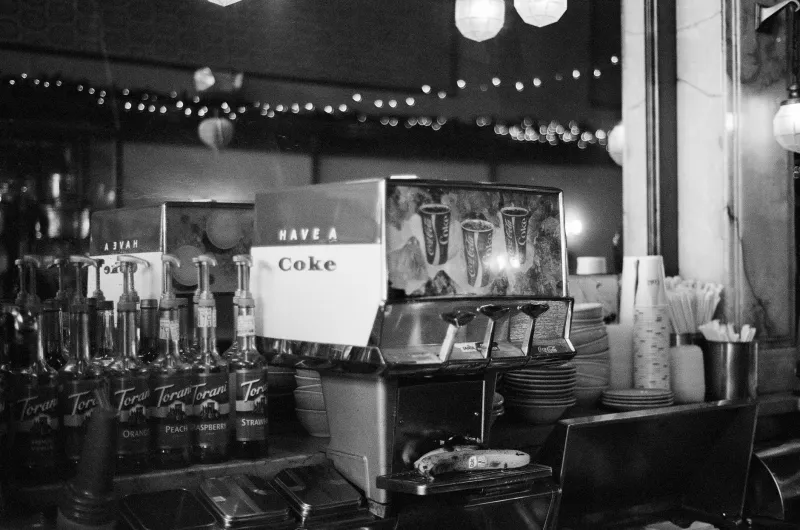
Somewhere between the aspirin shelf and the back prescription counter, there used to be a row of swivel stools. Red vinyl, usually. Chrome trim, always. And behind the marble counter, a soda jerk who knew your name, your order, and probably your business — whether you'd shared it or not.
The American drugstore soda fountain. It sounds quaint now. Almost cartoonish. But for roughly seventy years, from the 1890s through the 1960s, it was one of the most genuinely communal spaces the country ever produced. Not because anyone designed it that way. But because people kept showing up, and kept talking, and kept coming back.
How a Pharmacy Became a Living Room
The soda fountain started, oddly enough, as a health concept. Carbonated water was believed to have medicinal properties in the mid-1800s, and pharmacists began dispensing it alongside their remedies. By the 1880s, flavored syrups had entered the picture. By the turn of the century, ice cream had joined the party. And somewhere in that evolution, the counter stopped being a dispensary and started being a destination.
Drugstores added stools. Then they added booths. Teenagers discovered that a nickel Coca-Cola could justify an hour of occupation. Working men found it was a faster lunch than going home. Elderly women realized it was warmer — and more interesting — than sitting alone. The fountain became, by accident, what urban planners now spend millions trying to engineer: a space where different kinds of people actually mixed.
And unlike a bar, it was open to everyone. Kids. Grandmothers. The guy who'd just gotten fired. The couple celebrating an anniversary. The teenager nursing a broken heart over a chocolate phosphate. The soda counter didn't card you, didn't dress-code you, and didn't charge you much. It just let you sit.
The Person Behind the Counter Mattered More Than You'd Think
A good soda jerk — and yes, that was the actual job title, derived from the motion of pulling the syrup lever — was part chemist, part bartender, part therapist. They built drinks to order, often improvising based on what a customer seemed to need rather than what they asked for. They remembered that Mrs. Callahan liked her cherry lime rickey with extra lime. They knew that the Hendersons' kid had been sick because his mother mentioned it the week before.
This wasn't nostalgia-bait. It was a genuine information network. In an era before everyone carried a phone and before neighborhoods had Facebook groups, the soda counter was where local knowledge circulated. Who was hiring. Who had passed away. Which family was struggling. Which couple had gotten engaged. The person behind the counter absorbed all of it and, carefully, redistributed it.
That kind of ambient community intelligence is almost impossible to replicate digitally. It required physical presence, repeated over time, in a space with no particular agenda.
The Ritual Was the Point
Here's what made the soda fountain different from modern coffee culture, even though both involve a counter, a drink, and a few minutes off the clock: the fountain had almost no transactional pressure.
You weren't buying a $7 oat milk latte to justify using the WiFi. You weren't performing productivity on a laptop. You weren't there to be seen in the right neighborhood at the right café. A fifteen-cent sundae bought you as long as you wanted to stay. Nobody hustled you toward the door. The economics were slow and the atmosphere matched.
Compare that to the modern drive-through, which represents the complete inversion of the fountain's logic. The drive-through assumes you want your interaction minimized. It assumes you have somewhere more important to be. It optimizes for throughput, not connection. You don't even have to leave your car. The transaction is the entire relationship.
The soda counter assumed the opposite: that the drink was just an excuse, and the real product was the time spent getting it.
What Killed It
The decline came in layers. Suburban sprawl pulled families away from the walkable town centers where drugstores clustered. The automobile gave people a reason to drive past, rather than stop in. Chain pharmacies replaced independent stores, and chain economics didn't support the labor costs of a full fountain operation. Television gave people a reason to stay home in the evenings instead of drifting toward the corner.
By the late 1960s, most soda fountains were gone. A few survived in small towns and nostalgic holdouts. Some were deliberately preserved as tourist attractions, which only underscored how thoroughly the original thing had vanished. You can't reconstruct organic community gathering as a theme.
The Gap That Remains
We've been trying to fill the space ever since. Coffee shops came closest — Starbucks literally borrowed the language of the 'third place,' the sociological term for a social environment that isn't home or work. But the economics of modern coffee culture have always pointed in the wrong direction. The price point excludes, the WiFi encourages isolation, and the design increasingly favors mobile orders over counter conversations.
Social media promised connection and delivered something else: the sensation of community without its texture. You can have ten thousand followers and still have nobody who remembers how you take your coffee.
The soda fountain didn't solve loneliness. But it created the conditions in which loneliness was harder to sustain. It put people in the same room, at the same counter, with a shared reason to be there and no particular reason to leave quickly. That combination — accidental, affordable, unhurried — turns out to be surprisingly difficult to engineer on purpose.
Somewhere between the cherry syrup and the chrome stools, America had something it didn't fully recognize as valuable until it was gone. That's usually how it goes.