Fifty Bucks a Week and a Future: When a Paper Route Was a Real Job
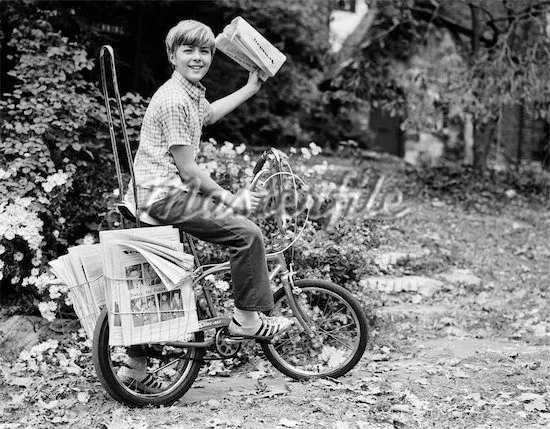
Photo: vintage 1950s paperboy delivering newspapers on bicycle suburban street, via i.pinimg.com
The Job That Built a Generation
Somewhere around 1962, a fourteen-year-old in suburban Ohio named Gary woke up every morning at 5:15, folded sixty newspapers into tight cylinders, loaded them into a canvas bag, and pedaled his route in the dark before school started. By the end of the month, he'd earned enough to cover two months of car insurance, contribute to a savings account his dad helped him open, and still have walking-around money on Friday night.
That wasn't unusual. That was just what a paper route was.
For roughly four decades spanning the mid-twentieth century, the newspaper delivery route was one of the most effective financial on-ramps ever designed for young Americans. It wasn't glamorous. It wasn't easy. But it was real — real money, real responsibility, real consequences if you skipped a day or lost a customer.
And then, quietly and almost completely, it disappeared.
What a Route Actually Paid
At its peak in the 1950s and '60s, a well-managed paper route could generate the equivalent of $400 to $600 per month in today's dollars — sometimes more in dense suburban neighborhoods with high subscriber counts. That's not pocket change. That's a part-time job that required no car, no work permit in most states, no boss hovering over your shoulder, and no minimum age requirement beyond "old enough to ride a bike."
More importantly, the economics of the route rewarded hustle in a direct, legible way. A kid who added ten new customers saw his check go up. A kid who collected dues on time kept his margins clean. A kid who showed up every single day — rain, sleet, July heat — built a reputation that translated directly into tips at Christmas that could rival a week's base earnings.
By the late 1960s, a diligent paperboy who managed his route well for three or four years could graduate high school with a few thousand dollars banked. In 1968, one year of in-state college tuition at a public university averaged around $400. The math was almost absurdly favorable. A paper route wasn't just spending money — it was seed capital for adulthood.
The Infrastructure Behind the Independence
What made the paper route work wasn't just the money. It was the entire ecosystem built around it.
Newspaper circulation departments actively recruited young carriers, provided training, and structured the route as a genuine small business. In many markets, carriers didn't just deliver papers — they purchased them wholesale from the publisher and sold them to subscribers at retail, pocketing the margin. The kid wasn't an employee. He was a micro-entrepreneur with a territory.
That distinction mattered enormously. It meant that a twelve-year-old was learning to manage accounts receivable, handle customer complaints, plan a schedule, and absorb the consequences of bad decisions — all before he could legally drive. The route was essentially a business school that paid tuition in reverse.
Parents understood this. Many actively encouraged their kids to take on a route not just for the income but for the discipline. The alarm clock went off whether you felt like it or not. The papers got delivered whether it was snowing or not. Customers expected consistency, and if you failed to deliver it, you heard about it.
Where It All Went Wrong
The collapse happened in layers, and none of them were sudden.
First came consolidation. As newspaper companies merged through the 1980s and '90s, circulation departments began shifting delivery away from kid carriers toward adult contractors with cars who could cover larger territories faster. The logic was efficiency. The casualty was the route as a youth institution.
Then came the internet. Newspaper circulation peaked in the mid-1980s and has been falling ever since. By 2020, daily print circulation in the United States had dropped to roughly 24 million — down from a high of more than 63 million in the 1980s. Fewer papers meant fewer routes. Fewer routes meant fewer kids getting that first taste of financial independence.
Today, the teenager who wants to earn real money faces a landscape that looks almost nothing like Gary's 1962 Ohio suburb. The gig economy offers apps and tasks, but most require a driver's license and a smartphone and come with none of the ownership structure that made the paper route genuinely formative. Babysitting and lawn mowing still exist, but they're informal, inconsistent, and don't scale.
The minimum wage debate has pushed many entry-level jobs toward automation or toward adults who need full-time income. The unintended consequence is that the labor market for teenagers — particularly young teenagers — has quietly contracted to near nothing.
What Got Lost Along the Way
The financial piece is the obvious loss. But there's something subtler underneath it.
The paper route gave young Americans a specific kind of confidence that's hard to manufacture in a classroom or a structured after-school program. It was the confidence that comes from knowing you are useful — that the world needs something from you, that you have a territory to manage, customers who depend on you, and a check at the end of the week that proves the arrangement was real.
That feedback loop — effort in, money out, responsibility carried — used to be available to almost any motivated kid regardless of family income or neighborhood connections. It didn't require a parent with the right contacts. It didn't require an unpaid internship in a city you couldn't afford to live in. It just required a bicycle and a willingness to get up early.
The gap between that world and this one isn't just economic. It's psychological. We've built a society that asks teenagers to prepare for adulthood for years before actually letting them participate in it. The paper route was one of the last institutions that trusted a kid with something real before he was technically ready — and somehow, the kids were almost always ready.
Gary, if you're wondering, used that savings account to buy a used Chevy at seventeen and put himself through two years of community college. He didn't think of it as remarkable at the time.
That's exactly the point.