Hello, Central: When Every Phone Call Required a Human Connection
The Voice That Connected America
"Number, please?"
For the first half of the 20th century, those two words were how every phone conversation in America began. Not with a dial tone, not with the mechanical whir of a rotary phone, but with the voice of a real person — usually a young woman sitting at a massive wooden switchboard, ready to physically connect your call by plugging cables into the right jacks.
These telephone operators weren't just employees. They were the human nervous system of American communities, the invisible threads that held neighborhoods together, and the last gatekeepers in a world that was rapidly becoming automated.
The Switchboard as Social Hub
In small towns across America, the telephone operator knew everything. She recognized voices before callers announced themselves, remembered who was visiting whom, and often served as an informal directory for community life. Need to reach Dr. Patterson but don't know his number? The operator knew he was making house calls on Elm Street. Looking for your husband who left work early? She might have connected a call to Murphy's Tavern twenty minutes ago.
 Photo: Murphy's Tavern, via boundbyflame.com
 Photo: Elm Street, via cdn.pixabay.com
This wasn't gossip — it was community knowledge. The switchboard operator was like a human Google, maintaining mental databases of who lived where, who worked when, and who might know what you needed to know. In an era before answering machines, she often took messages, relayed urgent information, and served as a communication lifeline for entire communities.
Urban operators handled hundreds of calls per day, but even in big cities, they developed relationships with regular callers. They knew which businessman called his wife every day at noon, which grandmother checked on her grandchildren every evening, and which young man was working up the courage to ask out the girl down the street.
The Technical Ballet
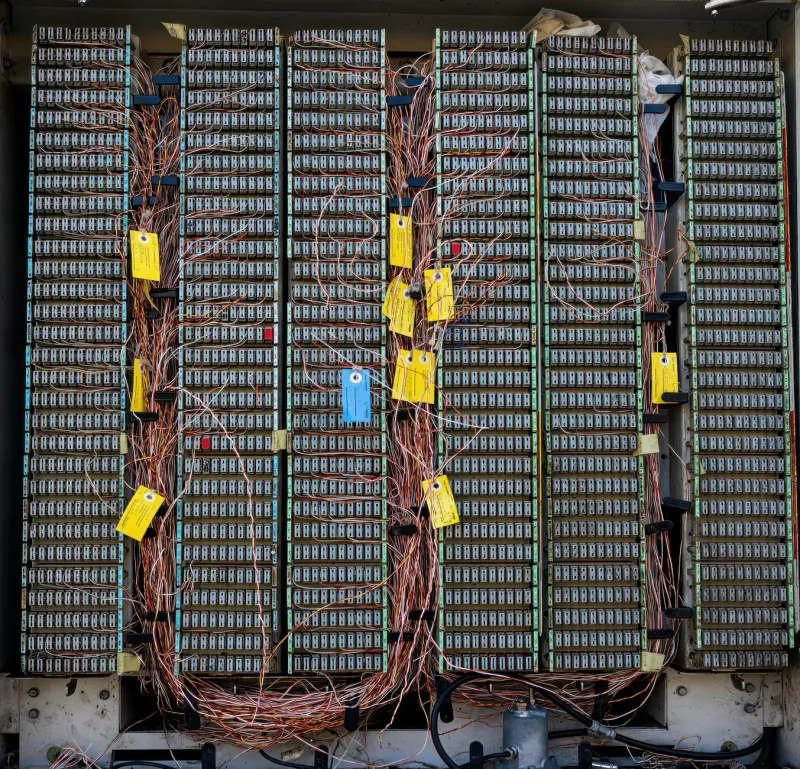
Operating a manual switchboard was like conducting an orchestra while solving a puzzle. The operator sat before a wall of cables, jacks, and lights, each representing a potential connection. When someone lifted their phone, a light would flash on the board. The operator would plug in her headset cable and ask for the number.
Then came the real skill: physically connecting the call by running a second cable from the caller's line to the recipient's line. For long-distance calls, this became a relay race, with operators in different cities connecting segments of the call until the circuit was complete.
Busy signals were personal interactions. "I'm sorry, that line is busy. Would you like me to try again in a few minutes?" The operator would literally attempt the connection multiple times, updating callers on the status and sometimes offering to take a message if the line remained occupied.
Emergency Response Before 911
Before emergency services, there was the operator. Fire, police, medical emergencies — all went through the same switchboard that handled everyday calls. Operators were trained to recognize panic in a caller's voice and to connect emergency calls faster than any automated system could manage.
During disasters, operators often stayed at their posts far beyond safety, maintaining communication lines as floods rose or fires spread. They became heroes not through dramatic action, but through the simple act of keeping people connected when connection meant survival.
The operator knew which doctor was on call, which fire station was closest, and which neighbor had a car to help with an emergency. This knowledge wasn't stored in databases — it lived in the minds of women who understood that their job was about more than just connecting wires.
The Beginning of the End
Automatic switching technology existed as early as the 1890s, but it took decades to replace human operators entirely. The transition wasn't just technological — it was cultural. Communities resisted losing their human connection, literally.
Dial phones required users to learn a new skill and accept that mistakes meant starting over. No human voice would confirm you were calling the right number or suggest alternatives if the line was busy. The mechanical precision of automatic switching eliminated both errors and the personal touch that made phone service feel like community service.
By the 1960s, most American cities had converted to automatic switching. The last manual switchboard in the United States didn't close until 1983 — a small town in Connecticut that held onto human connection longer than anywhere else.
What We Traded Away
Modern phone systems are marvels of efficiency. We can call anywhere in the world instantly, connect multiple parties simultaneously, and access information that would have taken operators hours to research. But something fundamental was lost in the translation from human to machine.
The operator represented a different model of technology — one that enhanced human connection rather than replacing it. She was artificial intelligence before computers, a search engine before the internet, and customer service before call centers.
When we eliminated the operator, we gained speed and lost relationship. We gained efficiency and lost community knowledge. We gained automation and lost the reassuring presence of someone who knew our voice and cared about our connection.
From Operator to Algorithm
Today's automated phone systems are the direct descendants of those manual switchboards, but they've inherited only the technical function, not the human wisdom. Voice recognition software tries to understand what we want, but it can't ask about our sick mother or remember that we always call our brother on Sundays.
We've replaced the operator's "Number, please?" with "Press 1 for English" and "Please listen carefully as our menu options have changed." We've traded personal recognition for voice prompts, community knowledge for automated directories, and human judgment for algorithmic routing.
The gap between then and now isn't just technological — it's philosophical. The telephone operator represented a world where technology existed to connect people, not just transmit data. She was proof that efficiency and humanity could coexist, that progress didn't require abandoning the personal touch.
The Last Human Voice
In eliminating the operator, America took its first major step toward a world where machines mediate human connection. She was the last human voice most people heard before reaching their destination, and her disappearance marked the beginning of our ongoing relationship with automated systems that serve us efficiently but never really know us.
The telephone operator wasn't just a job — she was a bridge between the intimate scale of community life and the vast network of modern communication. When that bridge disappeared, we gained a more connected world but lost something harder to quantify: the comfort of knowing that someone, somewhere, was personally invested in making sure we reached each other.
Every time we navigate another phone tree or repeat our account number to another automated system, we're experiencing the echo of that loss — the gap between the human connection we once had and the efficient isolation we've learned to accept.