Lost Without It: What Happened to Your Brain When the Map Was All You Had
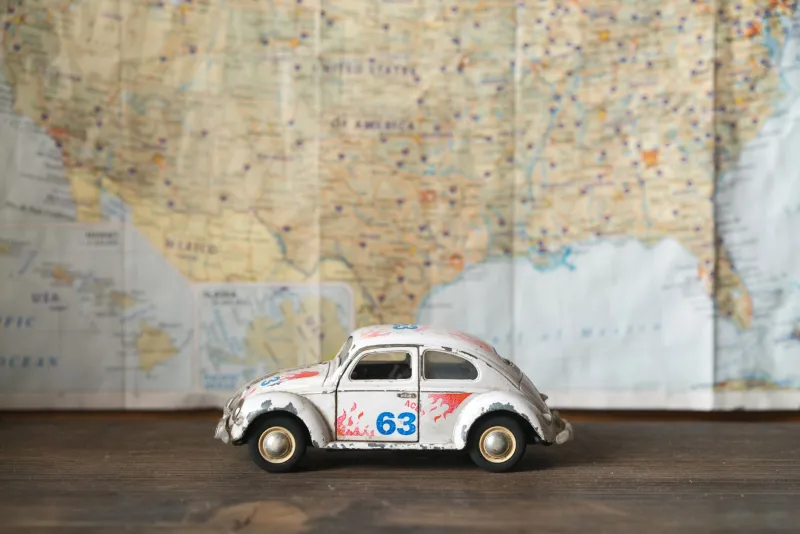
If you drove anywhere in America before roughly 2007, you know the particular anxiety of the wrong turn. Not the calm recalculation of a GPS voice — "turn around when possible" — but the real thing: that slow creeping suspicion that you've been heading south when you should have been heading west, somewhere in an unfamiliar suburb with no obvious landmark and a gas station that looks exactly like the last gas station.
You pulled over. You unfolded the map — badly, always badly, the accordion creases never quite cooperating — and you figured it out. Or you didn't, and you stopped somewhere and asked a person, which was its own small social transaction that required a kind of confidence and willingness to be wrong in public that GPS has made nearly obsolete.
That whole experience, frustrating as it was, was doing something to your brain. Something useful. Something that smartphone navigation has quietly stopped doing.
The Map Was a Model of the World
Reading a paper map isn't just reading. It's spatial reasoning in real time — the cognitive work of translating a flat, abstract representation into a three-dimensional understanding of where you are and where you need to go.
You had to orient the map to your direction of travel. You had to identify your current position relative to landmarks you'd already passed. You had to project your route forward, keeping several turns in mind simultaneously, building a mental model of the journey as a whole rather than just the next instruction.
Over time, people who navigated this way developed what researchers call a "cognitive map" — an internal spatial model of their environment. Regular drivers in a city knew that neighborhood not just as a series of turn-by-turn instructions but as a place with shape and logic, a place they understood from the inside.
This wasn't trivial. Spatial reasoning is a foundational cognitive skill, linked to performance in mathematics, engineering, and complex problem-solving. The London taxi drivers who famously had to memorize "The Knowledge" — every street, landmark, and route in the city — were found in a landmark University College London study to have measurably larger hippocampi, the brain region responsible for spatial memory. Navigation, it turned out, was exercise for a part of the brain that matters a great deal.
What GPS Does Instead
GPS navigation is, in a specific technical sense, brilliant. It processes real-time traffic data, calculates optimal routes, adjusts to road closures, and delivers accurate turn-by-turn guidance with a reliability that would have seemed like science fiction in 1985.
It also, systematically, removes you from the cognitive work of navigation entirely.
When you follow a GPS, you're not building a spatial model. You're executing a series of commands. Turn left. Continue for 0.4 miles. Turn right. The destination arrives, and you have almost no internal sense of how you got there — no mental map, no understanding of the route as a whole, no ability to reconstruct the journey without the device.
Researchers at McGill University studied this directly, comparing people who navigated by GPS with those who navigated independently. The GPS users showed less activity in the hippocampus during navigation and, over time, showed reduced hippocampal volume. The brain region associated with spatial memory was, in measurable terms, getting less use — and responding accordingly.
A separate study out of the University of London found that people who relied heavily on GPS performed worse on spatial memory tasks and had more difficulty navigating in new environments without assistance. The skill, like any skill not practiced, was atrophying.
The Other Things You Lost When You Stopped Looking Up
Beyond the neuroscience, there was something else the map era built that GPS quietly dismantled: the habit of paying attention to where you were.
Navigating by landmarks meant you noticed things. You registered the water tower on the left, the red barn at the county line, the way the road curved after the old feed store. You built a felt sense of place — an awareness of terrain and environment that accumulated over years of driving the same roads with your eyes actually on the world rather than on a screen.
Asking for directions was its own small education. The person behind the gas station counter who told you to "turn left at the old Kroger — well, it's a Walgreens now, but everybody still calls it the old Kroger" was giving you not just a route but a piece of local history, a fragment of how a community understood its own geography. Those interactions, trivial as they seemed, were a kind of social fabric. Strangers helping strangers navigate the same landscape.
GPS replaced all of that with a disembodied voice and a blue dot. Efficient. Frictionless. And in the process, it made the landscape a backdrop rather than a subject.
Getting Somewhere vs. Knowing Where You Are
The difference matters more than it might seem. There's a distinction between arriving at a destination and actually knowing where you are — understanding a place well enough to move through it confidently, to connect it to other places, to have a sense of how it fits into the larger geography around it.
The map era built the second kind of knowledge, slowly and imperfectly, through the accumulated experience of navigating badly and then better. GPS delivers the first kind efficiently and delivers nothing else.
For most practical purposes, that trade is fine. You get where you're going. You're rarely lost. The stress of the wrong turn in an unfamiliar suburb is largely a thing of the past.
But something has changed about the relationship between Americans and the landscape they move through. Cities that people have lived in for years remain mysterious to them in ways that previous generations wouldn't have recognized. Neighborhoods adjacent to familiar ones feel foreign. The mental map — the internal model of the world that navigation used to build — is, for many people, thin in a way it never used to be.
Somewhere in a glove compartment, there's a road atlas with coffee stains and a crease in the wrong place and a route traced in pencil through three states. It was folded wrong a hundred times. It was right about where you were going every single time.
And it was, without anyone realizing it, making you smarter.