The Room Where Strangers Used to Talk: What We Traded When We Made Doctors' Offices Fast
There was a particular kind of time that existed inside a doctor's waiting room in 1987. It was thick time. Unhurried time. The kind of time that forced you to sit with yourself — or, more often, with whoever happened to be sitting next to you.
You'd arrive, sign your name on a paper sheet, and take a seat in a room that smelled faintly of antiseptic and old magazines. Reader's Digest from four months ago. A People with a dog-eared corner. A Sports Illustrated that had already been read by twelve people before you. And then you waited. Not five minutes. Not ten. You waited the way people used to wait — with no escape hatch, no glowing rectangle to disappear into, no way to pretend you were somewhere else.
You waited, and sometimes, you talked to the person next to you.
The Long Sit
In the era before electronic health records, online scheduling, and patient flow optimization software, a wait of 45 minutes to an hour at a primary care office was perfectly normal. It wasn't a failure of the system. It was the system.
Physicians kept paper charts. Scheduling was done by phone, by hand, often by a single receptionist who also answered calls, verified insurance, and managed walk-ins. There was no algorithm smoothing out appointment gaps. When one patient ran long — a complicated diagnosis, a talkative elderly man who hadn't seen his doctor in two years — everyone behind him shifted accordingly.
This created a kind of enforced community. You were stuck, and so was everyone else. People griped about the wait in that friendly, low-stakes way Americans used to gripe. They swapped recommendations for other doctors. They asked each other what they were there for. A woman waiting for a follow-up might end up giving genuine, heartfelt advice to a nervous first-time patient in the next chair. It wasn't therapy. It wasn't social media. It was just people, briefly inhabiting the same slow pocket of time.
The Optimization Era
Something shifted in the late 1990s and accelerated hard through the 2000s. Healthcare systems began borrowing the language of manufacturing — throughput, patient flow, lean methodology. The goal was to reduce what administrators called "non-value time," which was, essentially, waiting.
By the 2010s, many practices had adopted electronic scheduling platforms that could model appointment demand in real time. Automated reminder systems reduced no-shows. Rooming protocols got patients into exam rooms faster. Some clinics began tracking door-to-provider time the way airlines track gate departure. A fifteen-minute wait became the benchmark. Some urgent care chains advertised wait times on digital signs outside, the way fast food restaurants post calorie counts.
And objectively? This was progress. Shorter waits meant more patients seen. More patients seen meant better access to care. Reduced idle time in the system meant lower overhead, which theoretically meant lower costs. Nobody who ever sat for an hour with a feverish toddler on their lap would argue that efficiency is a bad thing.
But something quietly left the building.
The Phone Fills the Gap
Here's the strange thing about efficiency: it doesn't create free time. It creates optimized time. When the wait dropped from forty-five minutes to twelve, patients didn't suddenly have thirty-three minutes of reflective quiet. They had twelve minutes — just enough to pull out a phone and start scrolling before their name was called.
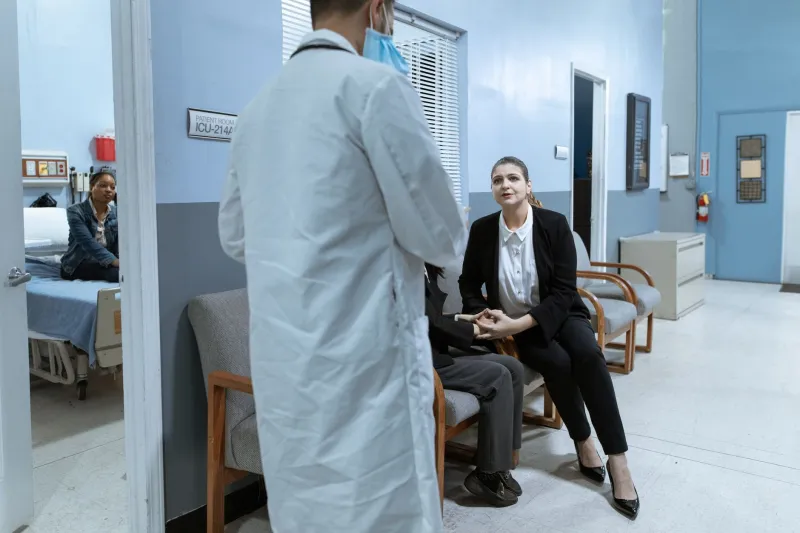
The modern waiting room is a study in parallel isolation. People sit two feet apart and exist in entirely separate digital universes. Nobody is reading the same bad magazine. Nobody is making eye contact with the stranger across from them. The overhead television, usually tuned to cable news with the sound off, goes unwatched. The receptionist, shielded behind a sliding glass panel, communicates through forms and a small tray for insurance cards.
It's not unfriendly. It's just... sealed. Everyone has retreated into their own portable world, and the room itself has become a holding space rather than a shared one.
What the Old Wait Actually Did
It's easy to romanticize the long wait. Nobody actually enjoyed it. But it served functions we didn't recognize as functions at the time.
It normalized the experience of being unwell. Sitting in a room full of people who were also not feeling their best had a quiet, leveling effect. You weren't alone in your symptoms. You weren't uniquely vulnerable. You were just a person, in a room full of people, all navigating the same imperfect body.
It also created low-pressure moments of human contact that are increasingly rare in American life. Sociologists have a term for these — "weak ties" — and research consistently shows they matter more to our wellbeing than we expect. A brief conversation with a stranger, a shared laugh over a dated magazine, a moment of mutual commiseration: these small exchanges add up. They remind us we're embedded in a community, not just passing through it.
And perhaps most importantly, the waiting room used to be one of the last places in American life that was genuinely egalitarian. The executive and the checkout clerk sat in the same chairs, flipped through the same magazines, waited the same amount of time. Healthcare might not have been equal in America — it certainly wasn't — but the waiting room was, at least, a shared room.
The Gap Between Fast and Full
Nobody wants to go back to forty-five-minute waits. That's not the point. The point is that when we solved the efficiency problem, we didn't stop to ask what else we might be solving away.
The modern healthcare system is faster, more data-driven, and in many measurable ways more effective than what existed thirty years ago. But it's also more transactional. The twelve-minute appointment. The portal message instead of the phone call. The waiting room that no longer waits.
We built a system optimized for throughput, and in doing so, we quietly removed the friction that used to make it human. What filled that space wasn't better connection. It was just a faster path to the exam room — and a phone to look at while you got there.
Sometimes the gap between then and now isn't measured in minutes. It's measured in what happened during them.