Everyone Knew Your Car Was in the Driveway: The Strange Trade We Made for Privacy
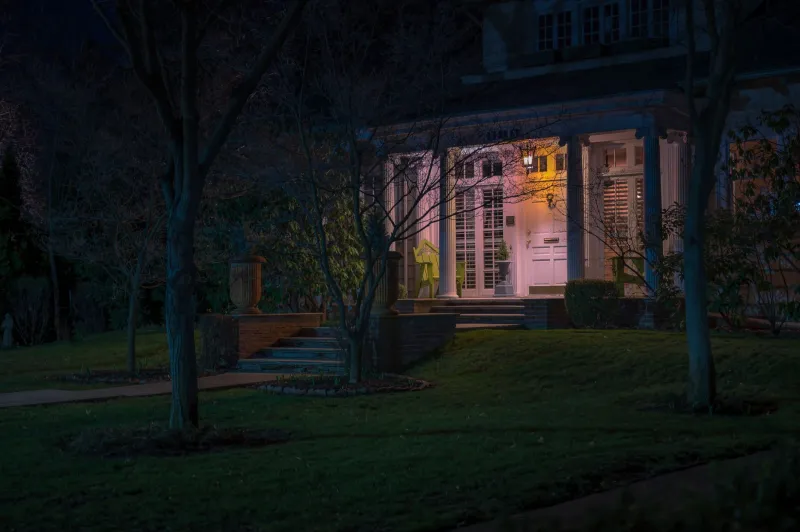
Mrs. Kowalski on the corner knew when you left for work. She knew when you came home late. She knew your mother had visited last Thursday because she'd seen the out-of-state plates. She knew you'd had a rough patch because your lights were on at two in the morning three nights in a row, and she'd mentioned it to her husband, who'd mentioned it to yours at the hardware store.
You probably found this maddening.
And if you grew up in that kind of neighborhood — the postwar American suburb before the garage door became the primary entrance, before the six-foot privacy fence became standard, before everyone retreated into their individual climate-controlled rectangles — you probably spent a good portion of your adult life trying to escape it.
A lot of us succeeded. And it turns out that success has a cost nobody fully advertised.
The Neighborhood That Watched
The close-knit American community of the mid-20th century was genuinely intrusive by modern standards. Neighbors tracked each other's schedules with a thoroughness that today would feel alarming. Front porches weren't decorative — they were observation platforms. People sat on them in the evening and watched the street and talked to whoever walked by, and everyone knew that this was the arrangement.
This visibility had a dark side. Small-town scrutiny enforced conformity in ways that were sometimes cruel. People who didn't fit the expected mold — in their family structure, their beliefs, their identity — paid a real price for that exposure. The same network that checked on you when you were sick also noticed and judged when you stepped out of line. The community that supported you also surveilled you.
For many Americans, particularly those who were different in ways the mainstream didn't accept, privacy wasn't a luxury. It was a survival need.
The move toward more private, more anonymous living wasn't just suburban sprawl — it was, in part, a genuine liberation for people who had been crushed under the weight of communal eyes.
Building the Walls
The architectural history of American suburbs tracks almost exactly with this retreat. Early postwar neighborhoods had shallow setbacks, connected sidewalks, and front-facing houses designed to engage the street. Garages, if they existed, were in the back.
By the 1980s and 1990s, the garage had migrated to the front of the house and grown to dominate the facade. The front door moved to the side or got lost entirely. Backyards got fenced. Cul-de-sacs replaced through streets. The design philosophy shifted from "connected to the neighborhood" to "protected from it."
People stopped sitting on porches. They started sitting on decks, walled in by wood and shrubs, invisible from the street. They stopped walking to the corner store and started driving to the big-box retailer on the highway. They stopped knowing their neighbors' names and started referring to them by house color.
This was, by design, more private. It was also, by consequence, more isolated.
The Loneliness Numbers
The health implications of this shift are not subtle. Social isolation has been linked to outcomes that rival smoking in terms of long-term health risk — elevated blood pressure, compromised immune function, cognitive decline, significantly higher rates of depression and anxiety. The U.S. Surgeon General issued an advisory in 2023 declaring loneliness a public health epidemic, noting that roughly half of American adults reported measurable levels of loneliness.
This didn't come from nowhere. It was built, slowly and deliberately, into the physical and social architecture of American life. We designed communities that made casual human contact less likely, then wondered why people felt disconnected.
The neighborhood that felt suffocating, it turns out, was also doing a lot of invisible structural work — providing a sense of being known, a low-stakes social network, an informal safety system. Mrs. Kowalski's surveillance was annoying. It was also a form of care.
The Algorithm Knows More Than She Did
Here's the part that makes the whole story strange: we didn't actually achieve privacy. We just changed who was watching.
The neighbor who knew your car was in the driveway had limited reach and mostly benign motives. She might gossip. She might judge. But she couldn't sell your behavioral patterns to a data broker, and she wasn't using your sleep schedule to optimize ad targeting.
The apps on your phone know more about your daily life than any nosy neighbor ever could. Your location, your purchases, your search history, your emotional state as inferred from your typing speed and scroll behavior, the content of your conversations if you've given the right permissions. This data is collected continuously, stored indefinitely, and monetized in ways most people have never read the terms for.
We escaped the neighbor who knew your business and handed that business to a corporation that knows infinitely more and uses it in ways that are structurally invisible and practically inescapable.
The scrutiny didn't disappear. It just became profitable.
What We Were Actually Looking For
The desire for privacy was never really about wanting to be unseen. It was about wanting control over who saw you and how. The problem with the old neighborhood wasn't that people knew you — it was that you couldn't choose what they knew, or what they did with it.
That's a reasonable thing to want. The tragedy is that in building our escape from it, we didn't land in a world of genuine autonomy. We landed in a world where we're isolated from the people physically around us while being completely transparent to systems we've never met.
The gap between then and now isn't just about neighborhood design or social habits. It's about what we thought we were trading for, and what we actually got. Less Mrs. Kowalski. More surveillance capitalism. Quieter streets. Emptier ones.